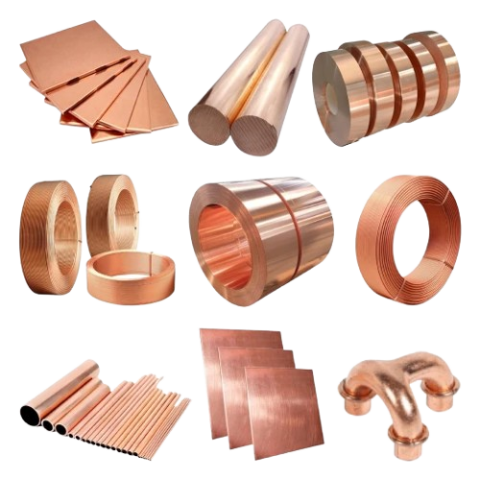
Copper-based extruded products are long, solid, or hollow shapes created by forcing heated copper or copper alloy billets through a shaped die. The extrusion process refines the metal's grain structure, eliminating defects and leading to products with enhanced mechanical properties and a smooth, precise finish.
Features/Roles/Variants of the product
Excellent thermal and electrical conductivity makes them ideal for electrical wiring, conductors, and heat exchangers.
Naturally resistant to corrosion, forming a protective layer of copper oxide over time. Specific alloys like copper-nickel offer exceptional resistance in marine environments.
The extrusion process results in a dense and uniform structure with enhanced mechanical properties, including high strength and ductility.
The extrusion process allows for the production of a wide range of custom and complex cross-sectional shapes and profiles, such as rods, tubes, and bars.
While pure copper is soft, specific alloys like free-cutting brass are engineered for superior machinability, leading to faster production and less tool wear.
Copper is naturally antimicrobial, which makes it a valuable material for high-touch surfaces in public and medical settings.
Copper is 100% recyclable without any loss of quality, contributing to sustainability and cost-effectiveness.
The extrusion process can produce products with a superior, smooth surface quality.
For high-volume and continuous production, extrusion methods like continuous extrusion can minimize waste and reduce overall manufacturing costs.
Product Specification
Basic Information
Hot Extruded Solid Bar.
Hollow Tubes and components of any profile made by Pure copper & Gilding Metal